Go to Blogger edit html and find these sentences.Now replace these sentences with your own descriptions.This theme is Bloggerized by Lasantha Bandara - Premiumbloggertemplates.com.
Go to Blogger edit html and find these sentences.Now replace these sentences with your own descriptions.This theme is Bloggerized by Lasantha Bandara - Premiumbloggertemplates.com.
Go to Blogger edit html and find these sentences.Now replace these sentences with your own descriptions.This theme is Bloggerized by Lasantha Bandara - Premiumbloggertemplates.com.
Go to Blogger edit html and find these sentences.Now replace these sentences with your own descriptions.This theme is Bloggerized by Lasantha Bandara - Premiumbloggertemplates.com.
Go to Blogger edit html and find these sentences.Now replace these sentences with your own descriptions.This theme is Bloggerized by Lasantha Bandara - Premiumbloggertemplates.com.
Apple AirPods and AirPods Pro successors could launch as early as 2021: Report
The upcoming AirPods Pro sequel is likely to look like Samsung Galaxy Buds Plus or Google Pixel Buds. Apple is said to be working on two new TWS buds. Not just the Pro, the second-gen regular AirPods will also receive an update.
According to a fresh Bloomberg report, the AirPods Pro would shed the stem design and shrink in size. The standard AirPods, on the other hand, will adopt the design language of its bigger sibling. It will sport a shorter stem and switchable ear-tips.
Besides aesthetics, the Apple earbuds will showcase newer wireless chips and improved battery performance, adds Bloomberg.
And the much-rumored and anticipated Apple over-the-year cans could also tag along. The so-called AirPods Studio is apparently going through some design tweaks to fix the tightness of the headband.
Lastly, the report also divulges Apple’s internal discussion to introduce a third HomePod to its smart speaker roster.
All these must sound interesting to you, especially if you are an Apple user looking forward to upgrading your audio gear.
The Galaxy F41 will be stepping in a royal rumble ring where value kings from Redmi, Poco, Realme, and even Samsung’s own M series are already exchanging blows to claim the title of best phone under Rs 15,000. So will the Galaxy F41 be able to stand its ground? Is this the phone you should buy? Let’s discuss in our Galaxy F41 review.
Samsung Galaxy F41 - user opinions and reviews
Samsung Galaxy F41 Unboxing
Samsung has stopped bundling protective cases in the box across all price segments. It started with Galaxy M31s (review), followed by the Galaxy Note 20 Ultra (review), Galaxy M51(review), Galaxy S20 FE (review), and now the Galaxy F41.
On unboxing the Galaxy F41 you will find the phone, a 15W adaptive fast charger, USB Type-A to Type C cable, a SIM ejector PIN, and documentation. There is no pre-installed screen protector on the display.
Samsung Galaxy F41 Specs
Model
Samsung Galaxy F41
Display
6.4″ Super AMOLED Infinity U, FHD+
Front Camera
32MP, 4K Video
Rear Camera
64MP + 8MP ultrawide + 5MP portrait, 4K video
Processor
Exynos 9611
Software
Android 10 with One UI skin
Battery
6000mAh with 15W charger
Memory
6GB LPDDR4x RAM + 64/128GB storage (expandable up to 512GB)
Misc. things
3.5mm jack, USB-C port, Dual 4G VoLTE SIM
Colors
Black, Blue, and Green
Price
Rs. 13,999 | Rs. 16,999
Samsung Galaxy F41 Review: Design and build
Looking at Samsung Galaxy F41 we were instantly reminded of the Galaxy M31 (review). Sure the new gradient color on the glossy polycarbonate back panel is relatively more appealing but the rectangular camera module on the top left corner, the oval-shaped fingerprint sensor, and tapered edges are the exact same as what we had on the earlier set of M30-series phones.
The same resemblance can be seen for the fascia. Expect an additional sensor at the back, there’s no difference between the two phones.
Having said that, this resemblance is not a problem from a buyer’s perspective. The Galaxy F41 is very comfortable to wield and convenient to handle – and that’s really something when you consider that there is a massive 6000mAh battery within.
Besides, Samsung isn’t skimping on the basics. Audio jack, dedicated card slot, and USB Type-C port are all there. The phone feels solid and there are no flexes or creaks in the body.
Samsung offers Galaxy F41 in Fusion Black, Fusion Blue, Fusion Green colors that should appeal to millennials. We have the Fusion Black variant with us and oh boy that sparkling gradient does look tempting.
So, overall, Galaxy F41 manages to absorb in a big battery and remains ergonomic. That’s perhaps a win when you consider phones priced under Rs. 15,000.
Samsung Galaxy F41 Review: Display
The Galaxy F41 packs an FHD+ AMOLED screen – which also makes it the most affordable phone with an AMOLED screen to launch in the last few months (post the GST Hike). The panel quality is decent too.
The Galaxy F41 screen is crisp and vivid. During my usage, I binged Netflix’s ‘Schitt’s Creek’ Season 6 on the Galaxy F41, and everything looked almost perfect. Yeah, the white point is slightly tilted towards cold tone but you can switch from Vivid to Natural color preset to fix that.
Speaking of Netflix, it comes with DRM L1 Widevine certification which is essential for online HD streaming. The 420 nits of peak brightness make the screen fit enough for occasional usage under direct sunlight. Samsung has shielded the screen under Gorilla Glass 3 scratch resistance layer.
Samsung Galaxy F41 Review: Performance and Software
Do you know what’s common among all Samsung phones priced under Rs 20,000? It is Exynos 9611 (no point for guessing that). All affordable phones in Samsung’s lineup right in 2020 are powered by a 2.3 GHz octa-core Exynos 9611 SoC based on 10nm process.
This is not a particularly snappy chipset or one that will allure gamers, but basic and moderate users should be fine.
The SoC is assisted by 6GB of LPDDR4X RAM and up to 128GB storage. Using the same chipset over several generations has also given Samsung enough time to optimize its Android 10 based One UI to function smoothly on the hardware. Day-to-day usage was smooth but yes the Exynos 9611 can’t quite match the Snapdragon 700 series options or MediaTek’s G-series gaming chips when it comes to brute force.
The One UI 2.0 is one of the better and tasteful Android skins in the market but there are generous helpings of bloatware to be wary of. Users are advised to pay attention to the initial setup process to uncheck suggested apps, lock screen posters, and marketing push notification service for a cleaner experience. Most of the third-party apps can be uninstalled.
Unlike most other new phones, Samsung continues to use its own dialer app and offers auto – call recording option – and depending on your needs, this could be a big advantage.
So, all said and done, the performance and software aren’t any different from what Samsung has been offering on its affordable phones this past year.
Samsung Galaxy F41 camera review
The Galaxy F41 packs three rear cameras and a 32MP selfie camera – similar to Galaxy M31. The primary 64MP sensor is still Samsung’s own GM1 and it’s paired with an 8MP ultra-wide and a 5MP depth sensor.
In proper day-light, the camera can capture vivid details in highlights and shadows. Focusing is mostly fast and dynamic range is wide. The primary camera however struggles to lock focus in close-ups.
By default, the primary camera combines four pixels to one and churns out 16MP images, but users also have the option to shoot full 64MP resolution images. We suggest that you only try the full resolution only in excellent lighting conditions.
There is some expected degradation in quality while shooting with the 8MP wide-angle camera, but images are still usable.
Shot with primary camera
shot on ultra-wide
Samsung software can deftly grab subject edges in the portrait or Live focus mode. The quality is quite good in proper lighting. Portrait shots have sharp details and good color accuracy.
Indoors and in low light, the camera quality deteriorates as is true for all phones in this price segment.
The F41 32MP selfie camera delivers detailed 8MP pixel-binned selfies. The Galaxy F41 smoothen out skin blemishes with its beautification feature and Samsung plans to add more custom filters in upcoming updates.
The Galaxy F41 also supports UHD video recording, super slo-mo, hyper-lapse videos. There’s Super Steady which crops footage from the ultra-wide camera for more stable videos.
Samsung Galaxy F41 review: Battery and audio
Samsung has been very generous with battery capacities on its affordable phones. The 6000mAh battery on the F41 could comfortably last for more than a day and a half on a single charge. The 15W adaptive fast charging is, however, quite slow by modern standards and takes around 2.5 hours for a full charge. But yes, with such a large tank even 50% is good enough to drive away all anxieties.
The Galaxy F41 has a mono loudspeaker that delivers about average results. However, the Dolby atmos support on headphones makes it a good content consumption device.
Samsung Galaxy F41 review verdict: should you buy it?
Samsung Galaxy F41 belongs to a new series but it strictly and safely adheres to the tried and tested M-series formula. This is perhaps ok because Samsung’s M30 series has been a massive success and appeals to consumers in India.
The Galaxy F41 offers an AMOLED screen for a very affordable price, has a very assuring 6000mAh battery capacity, a tasteful software, and, as always, will also benefit from Samsung branding.
The performance hardware isn’t class-leading but it should suffice for basic and moderate consumers. The camera performance is on par with what we usually see in this price segment.
It does sound like a sweet deal for the introductory effective price of Rs. 13,999 during the Big Billion Days 2020 sale.
The world doesn't end with this one escalating trade dispute, Huawei insists, so here's the Mate 40 series for you. We have the Mate 40 Pro for review, the high-end almost-flagship that sits just below the ultimate Mate 40 Pro+.
https://www.youtube.com/embed/YilrbdoyAvQ
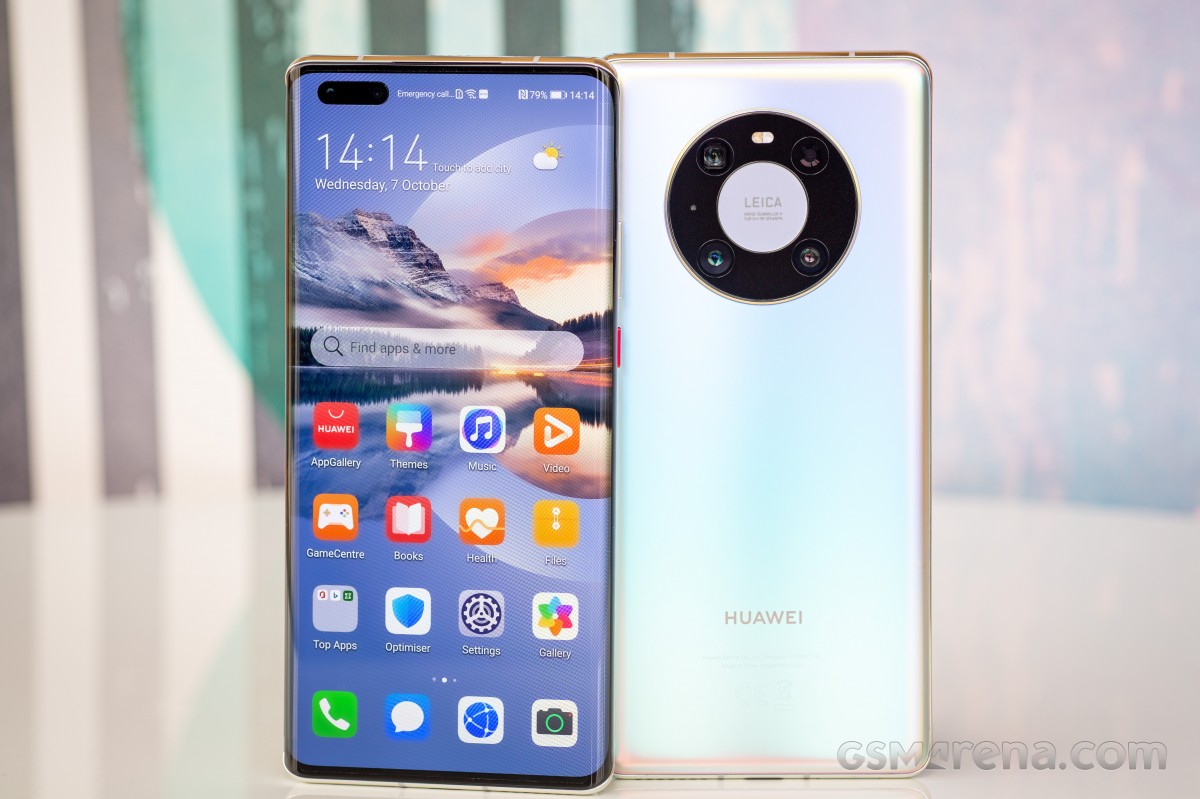
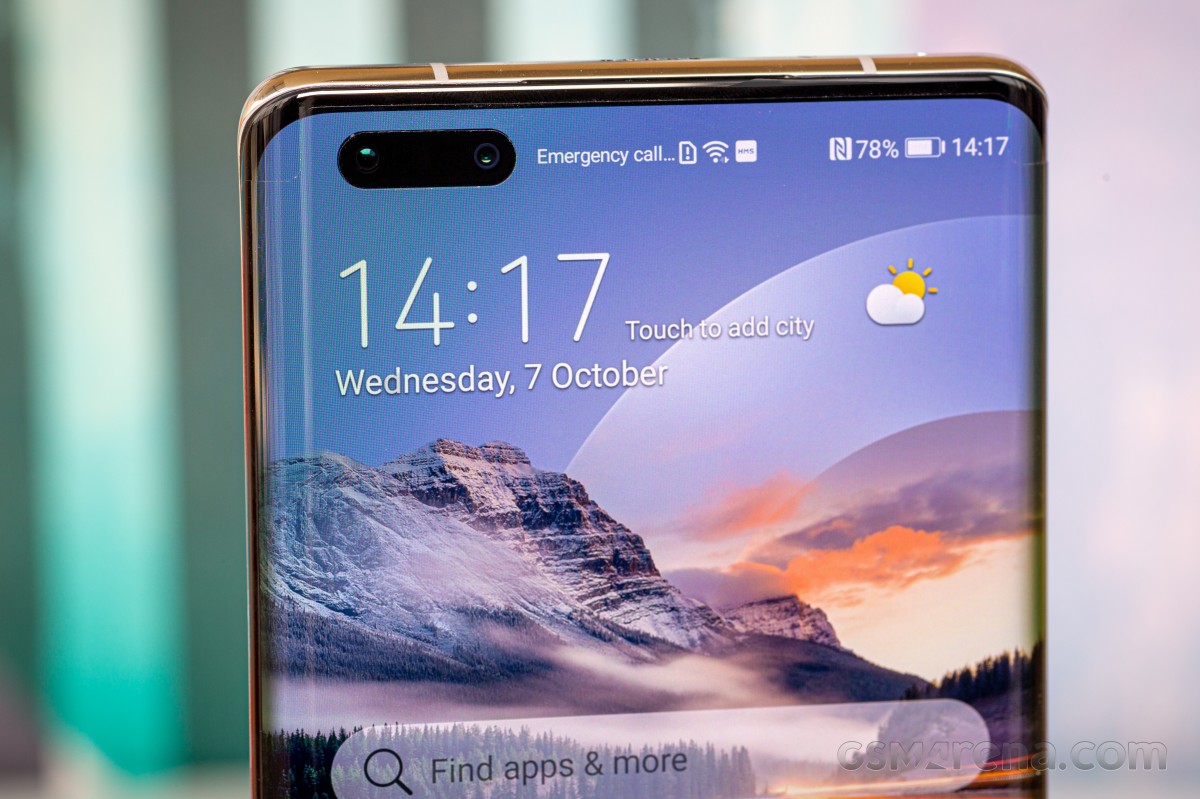
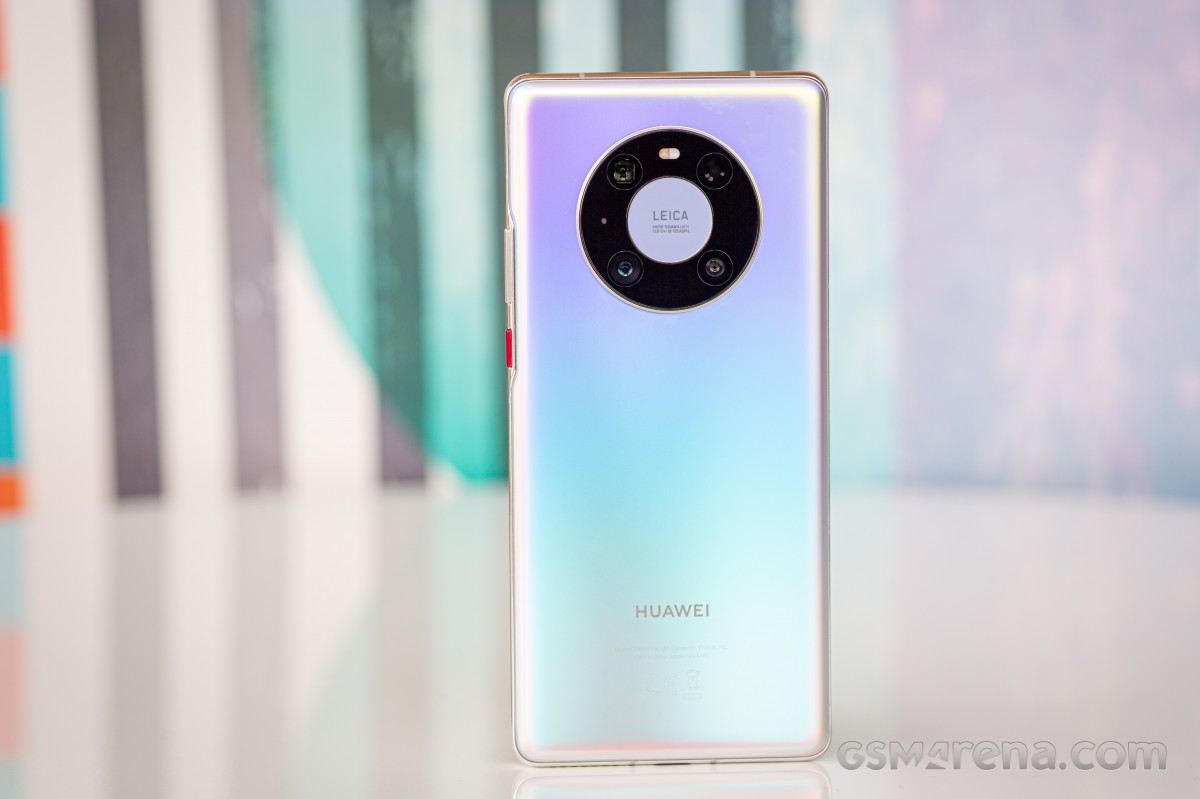
We say almost-flagship just because there's one better, but the Mate 40 Pro is nothing short of a top-tier handset. Immediately striking is the display - a 6.76-inch OLED that envelops the device's sides - similar to the Mate 30 from last year, but even more extreme.
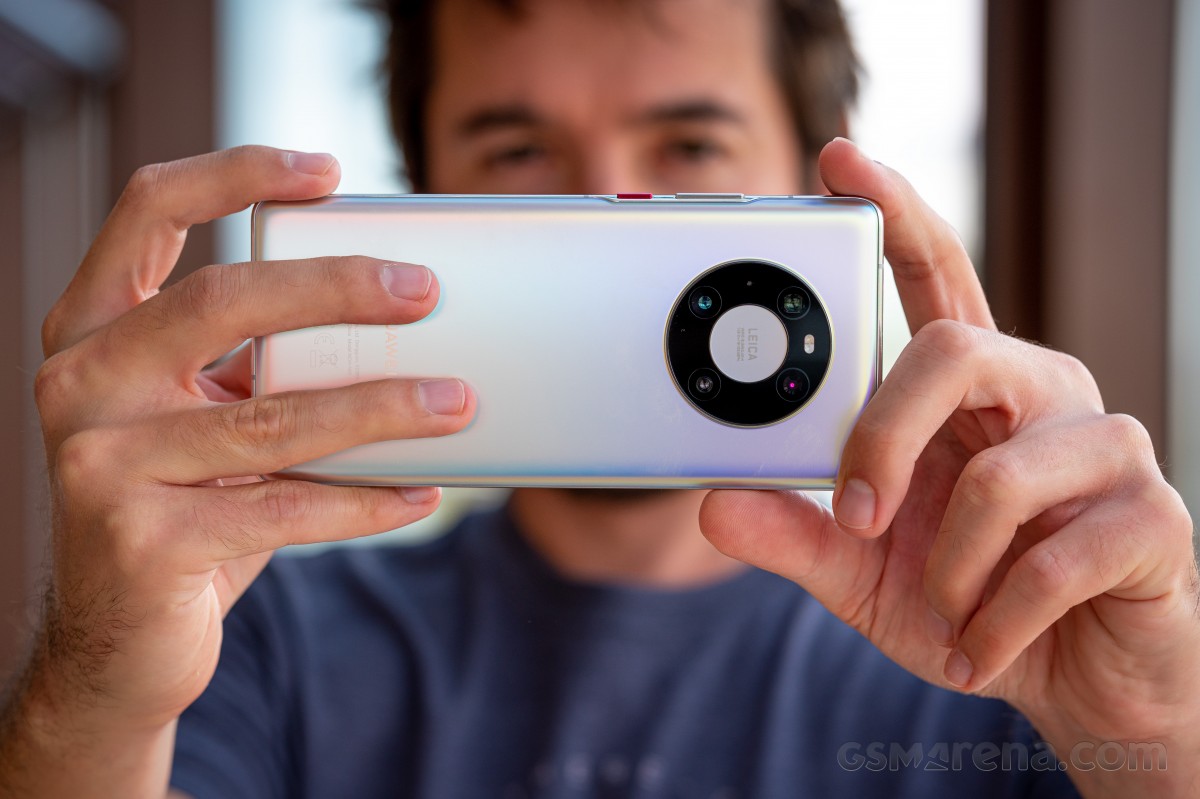
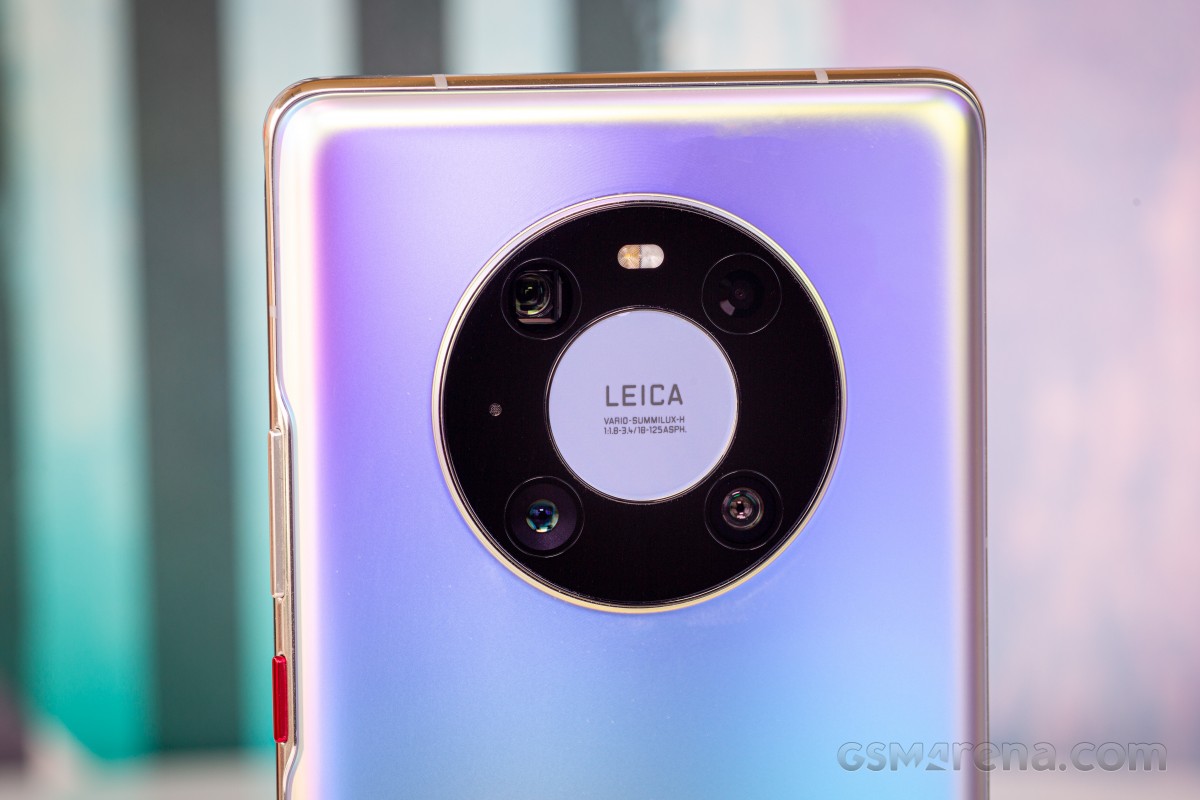
Flip over to the back, and you'll be greeted by a camera arrangement that you haven't seen before - so it turns out distinctive design is still possible. A proper tri-set of cameras sits inside that circle with a 50MP main unit and 5x periscope tele, both coming straight from the P40 Pro, and a new 20MP ultra-wide.
That's what you can see. What you won't be able to see is the new Kirin 9000 chipset, the first 5nm SoC for Android (Apple's A14 Bionic inside the iPhone 12 has one). Powering things is a 4,400mAh battery, fairly unimpressive, but that gets charged by a 66W adapter over a cable and up to 50W wirelessly - those aren't rookie numbers.
Huawei Mate 40 Pro specs
Body: 162.9x75.5x9.1mm, 212g; Glass front, aluminum frame; IP68 dust/water resistant; Colors: Black, White, Mystic Silver with glass backs, Yellow and Green with vegan leather backs.
Huawei hasn't skimped on the smaller niceties either, and the Mate 40 Pro comes with stereo speakers – two evenly matched units. The front-facing ToF cam provides secure face recognition, and there's another IR-based feature – a blaster up top to operate your old-school TV or AC unit. An IP68 rating is also par for the course in this segment. Sure, there's no 3.5mm jack, but does that really bother anyone at this point? Plus, there's headset in this box, unlike other, half-sized boxes.
Huawei Mate 40 Pro unboxing
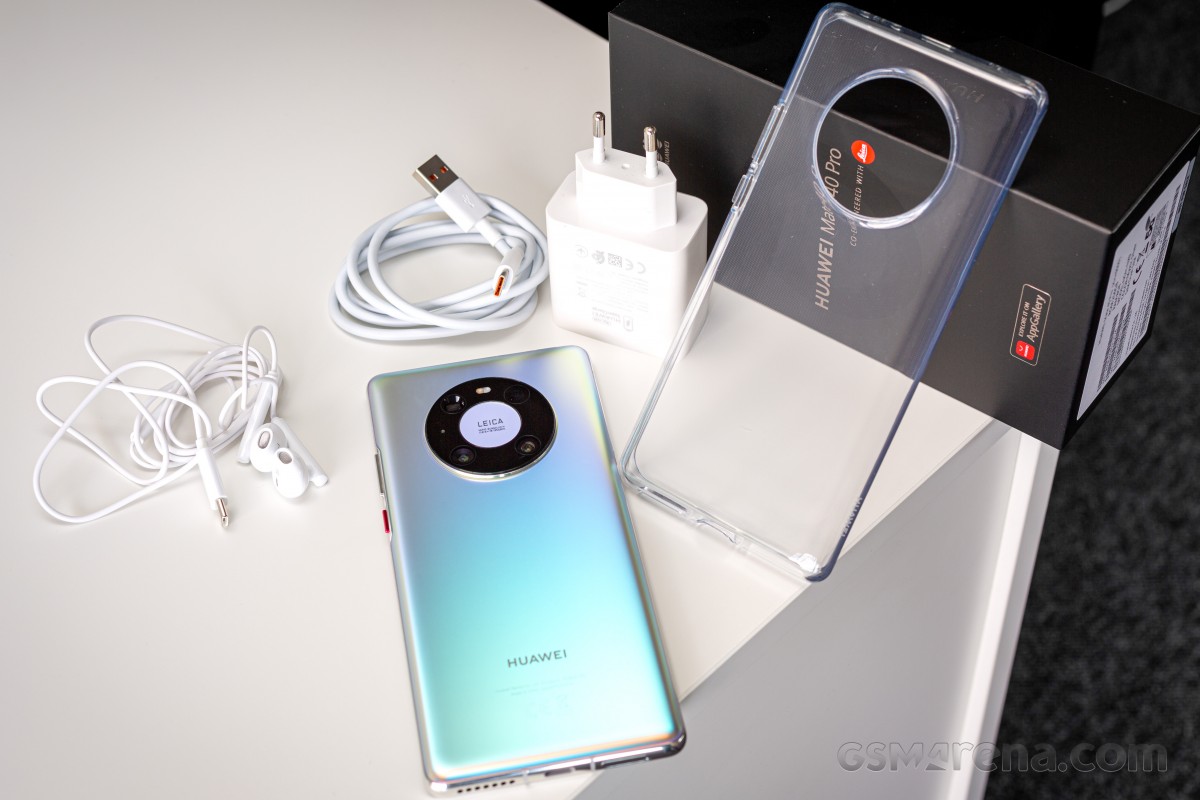
The Mate 40 Pro's retail box is the same as what we've gotten with previous Mates - black cardboard, golden lettering, red Leica dot on the front. Inside, there's a full set of accessories.
A powerful 66-watt adapter, which is still reasonably compact, is included as is a cable to go with it - since both pieces use the in-house SuperCharge technology you better hold on to them to get the maximum charging speeds.
There is a pair of earbuds, too, ending in a USB-C connector - that's the only wired interface on the Mate 40 Pro. There's no USB-C-to-headphone jack adapter included.
A new addition this time is a protective case. It's a basic clear silicone one, but it's thick and provides protection straight out of the box. It also doesn't interfere with the touch operation on the curved display edges but does rob you of feedback when operating the physical buttons.
Design
The Mate 40 Pro isn't quite your ordinary slab of a smartphone - it does have some standout design elements. The waterfall display, the rear camera assembly, the pill-shaped selfie camera cutout if you will.
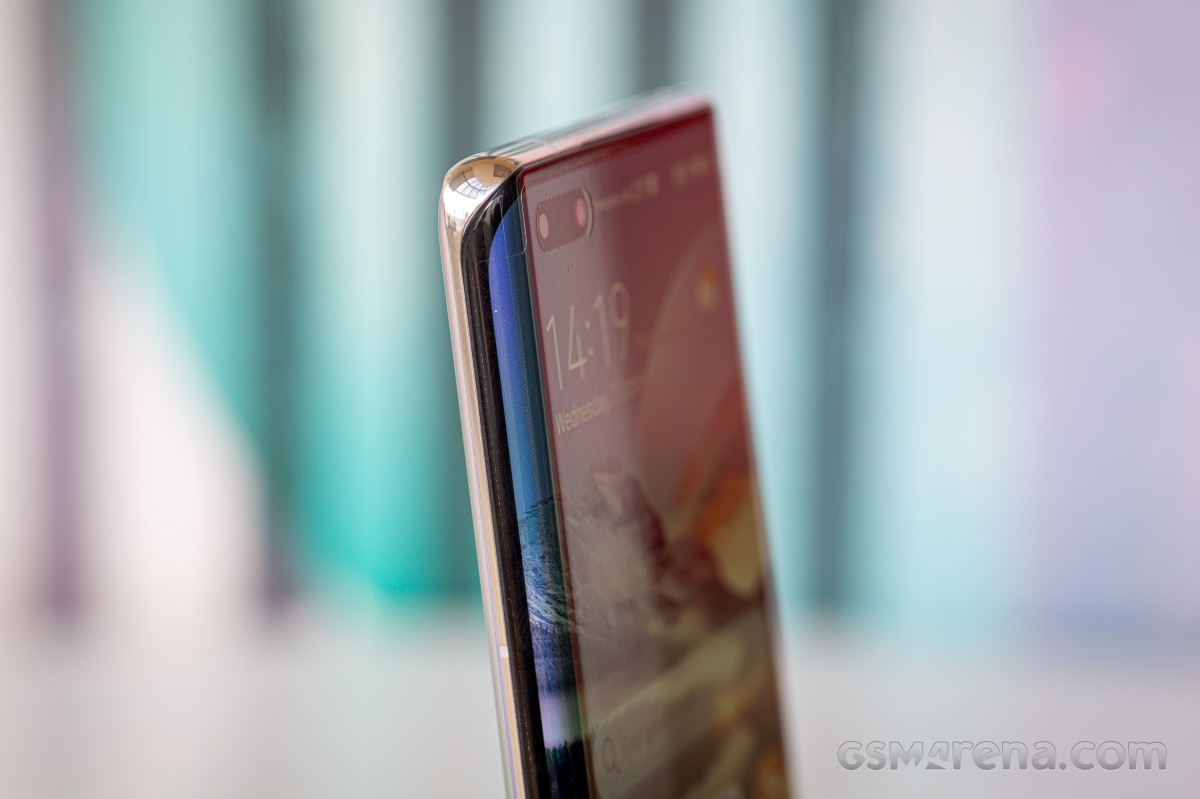
Huawei says the OLED panel takes an 88-degree turn to cover the sides of the phone and we're seeing no reason to doubt that claim. They've gone a notch further compared to the already pretty curvy sides of last year's model though perhaps you wouldn't be able to tells it's 88 or 80 or whatever degrees - it's one curved display, for sure, of the type that Samsung's been moving away from for a few generations.
There's a sizeable cutout in that display, one that houses the selfie cam and the ToF bits for 3D face recognition. On last year's model those were in an iPhone-style notch, but Huawei switched to a pill-shaped implementation on the P40 Pro and that design makes it to the Mate 40 Pro. Apple has the notch, Huawei has this cutout and neither is exactly pretty, but the Mate does allow you to hide it in software. Having said that, as recent years have thought us, you learn to ignore notches or punch-holes in no time.
Unlike the P30 Pro, P40 bunch and the Mate 30 Pro that vibrate their displays for voice calls, the Mate 40 Pro has a conventional earpiece - sound comes out through a thin slit where the display glass meets the aluminum frame.
That comes hand in hand with another most welcome development - this Mate here has stereo speakers. It's two identical ones, one firing out the top of the device, the other - from the bottom.
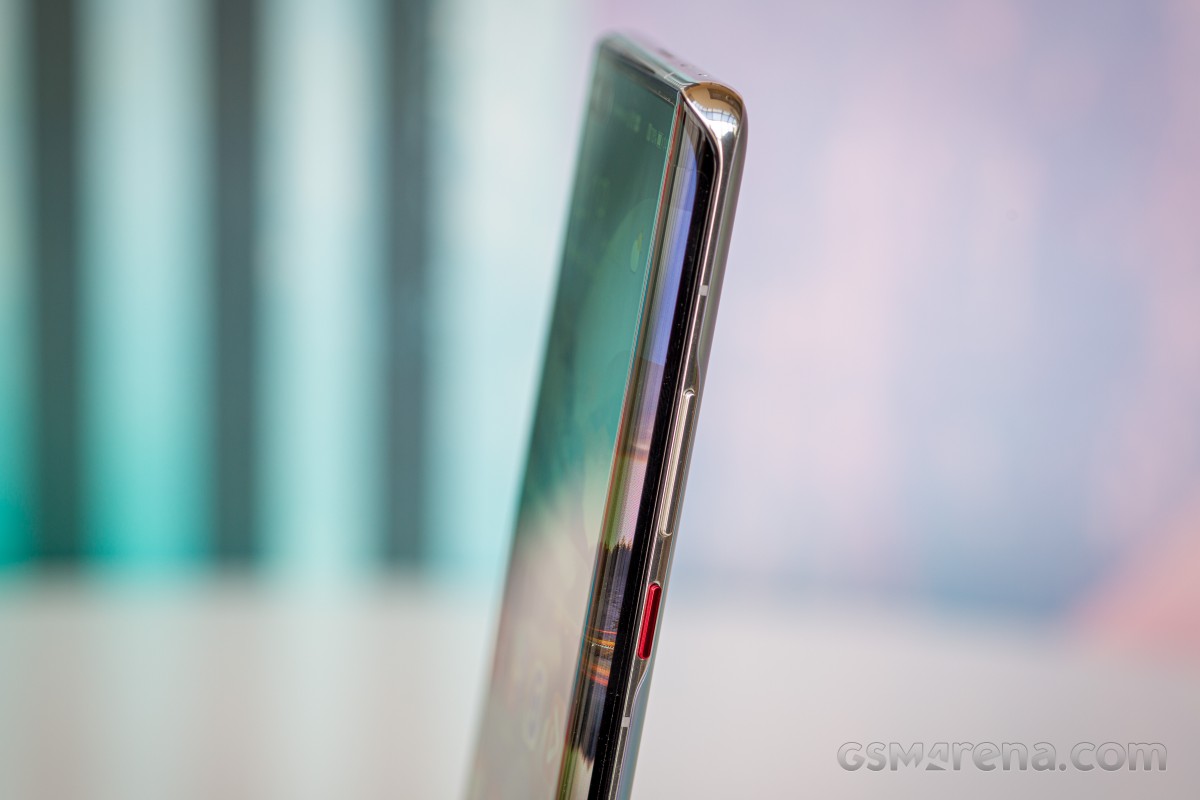
One more notable step in the right direction is the return of the physical volume buttons. Entirely software-based on the Mate 30 Pro, volume control operation was fiddly, needed learning, and even then worked some of the time. The Mate 40 Pro has a proper mechanical rocker for this task.
Of course, with the extreme curve of the display, the buttons are... below the equator. While not strictly the greatest example for excellent ergonomics, they do at least work every time.
Immediately noticeable when you pick up the Mate 40 Pro after holding last year's model is that the new one feels bigger. While the numbers do objectively say so, it's also a tangible difference that the 2.4mm of added width and 0.3mm of extra thickness may not directly communicate. It's a big phone though, and as big phones go, the Mate is... ordinary, if that makes sense.
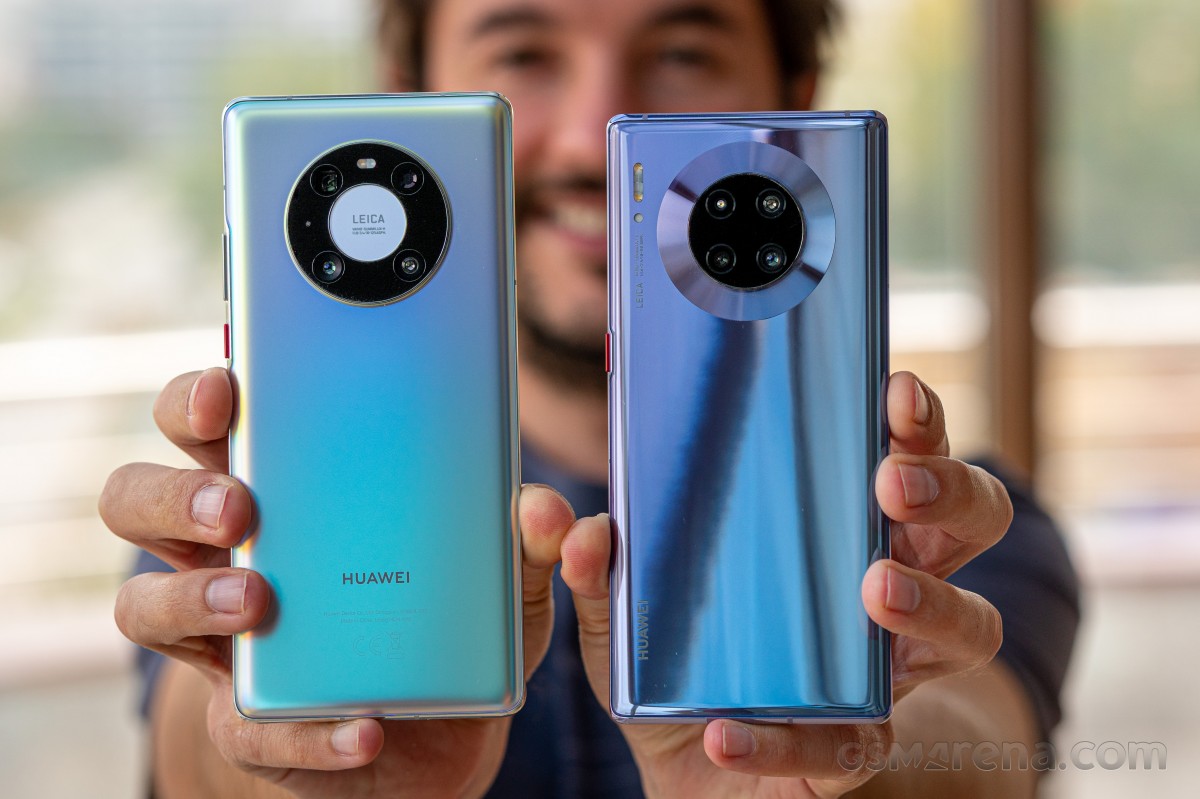
Mate 40 Pro (left) next to Mate 30 Pro
There's nothing ordinary about its back, however. The unique circular camera configuration is entirely a by-product of engineering considerations, we've been told, and not a form-over-function decision - the arrangement of the modules called for that particular design.
The four cameras are placed inside a black circle, the mandatory Leica logo in the middle. Without the circle as an accent, Huawei could have made one large rectangle with the four modules in the corners. That wouldn't have been 1/3.14 as cool, though, would it?
There's also the matter of color and finish. Our review unit is in the Mystic Silver colorway and comes with a matte glass back that does the usual pearl-like play with light - only even more of it. Black and White options will be available with similarly finished glass backs. Black and Mystic Silver be the ones you can get in Europe.
Two more variants will exist and those will have vegan leather on their backs. One will be in 'Sunflower Yellow', the other - 'Olive Green'.
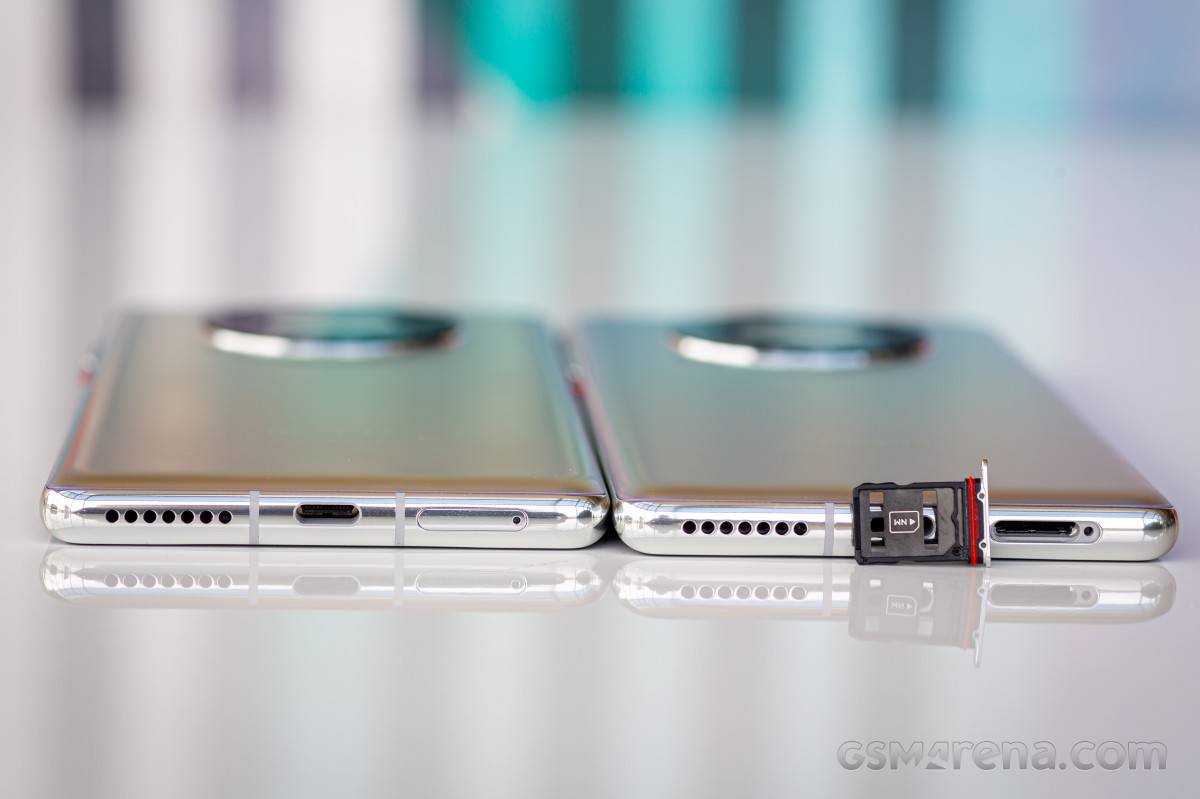
As any self-respecting high-end phone, the Mate 40 Pro has an IP68 rating for dust and water protection. The one place you can tell care has been taken to waterproof the handset is the card slot - there's a red gasket on the card tray for environmental protection. The tray takes a nano SIM and an NM card (Nano Memory) back to back - it's one better than no memory expansion capability, but still no microSD.
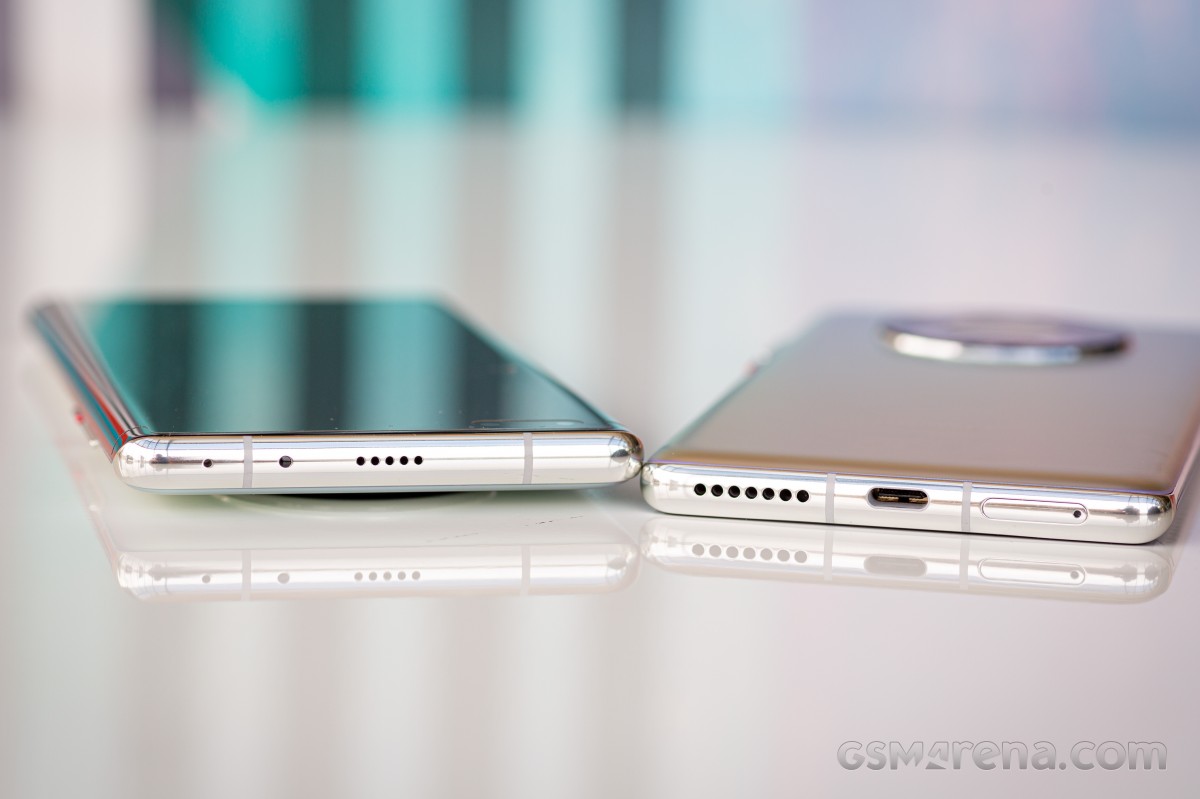
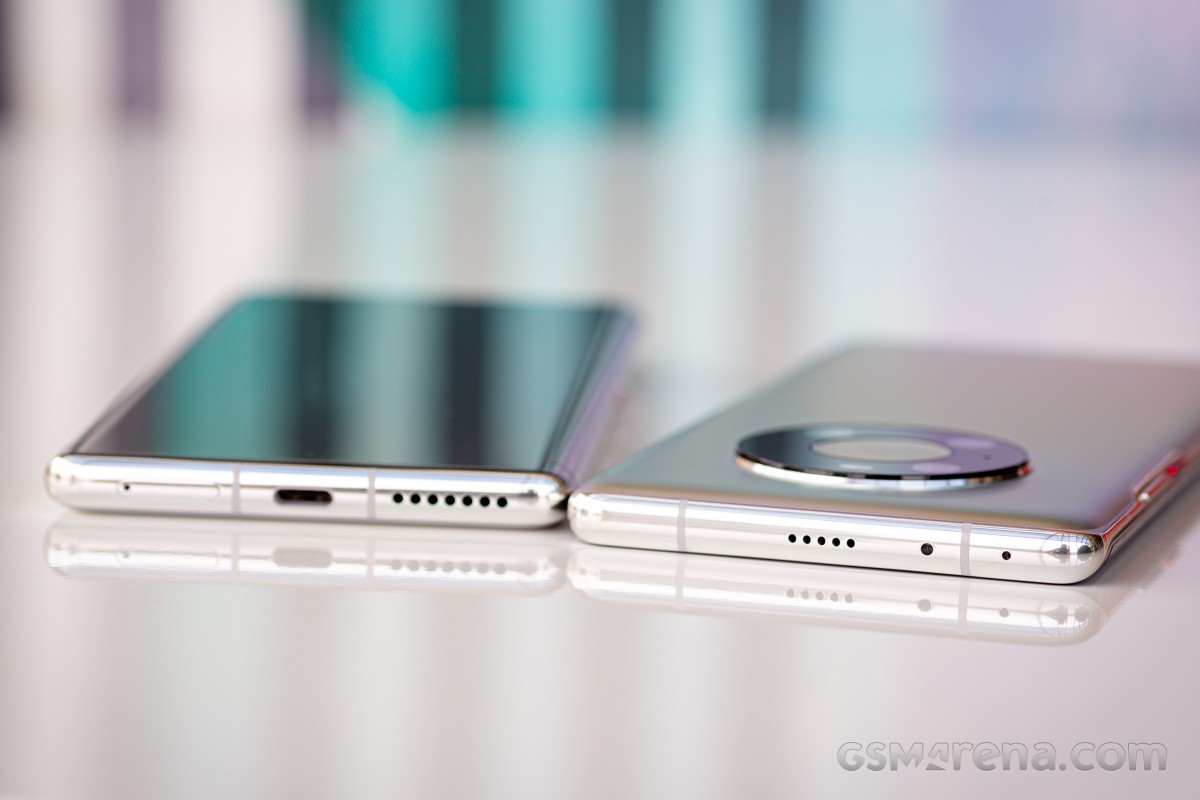
The card slot is on the bottom where you'll also find the USB-C port, the bottom loudspeaker and the primary mic. Meanwhile, up top, a second mic keeps company to the other loudspeaker and the IR emitter - we're glad Huawei keeps fitting those in phones, even as the number of people looking for one is progressively shrinking.
6.76-inch OLED can go as high as 90Hz
The Mate 40 Pro is equipped with a 6.76-inch OLED display that spills over to its sides. Resolution is a somewhat odd 1344x2772px - it's even weirder than the P40 Pro's 1200x2640px. The aspect ratio going by the Mate's numbers is 2.0625:1 (or 18.6:9, if 9 is a more familiar denominator) while pixel density works out to 456ppi.
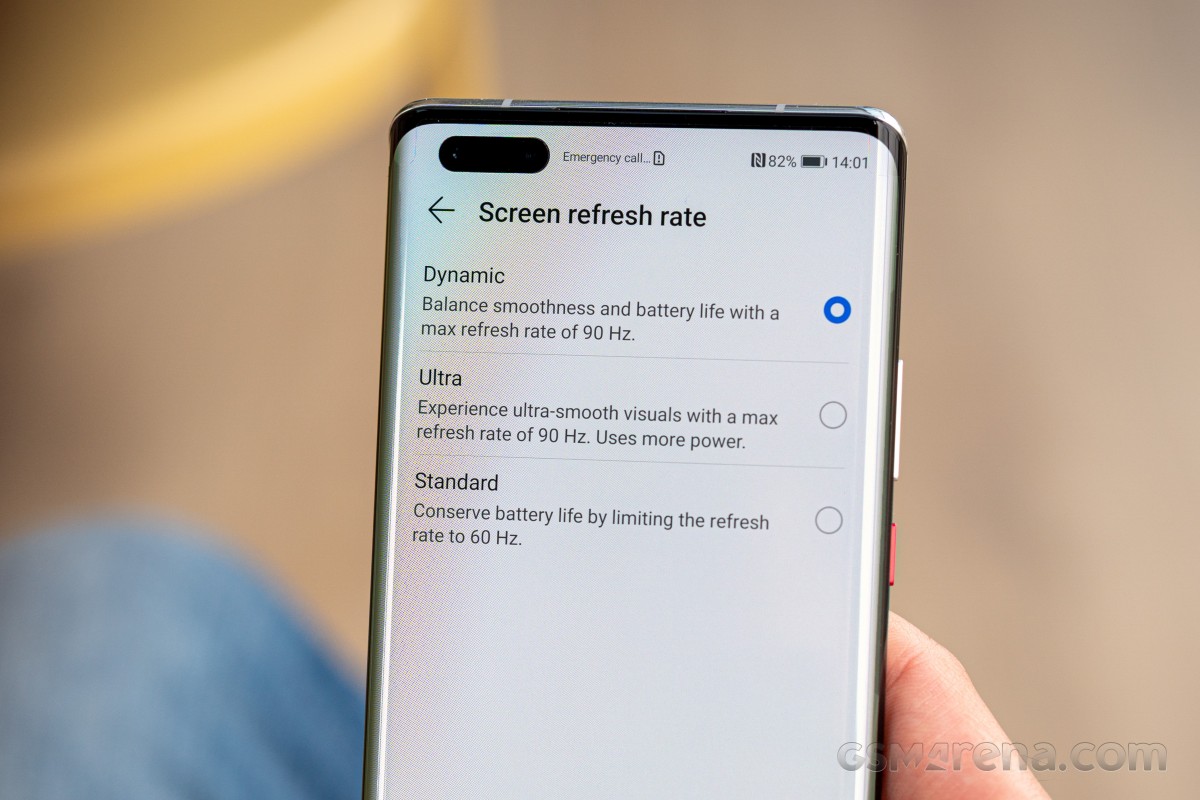
The panel also supports a 90Hz refresh rate, same as the P40 Pro and P40 Pro+. That can be set to Standard (60Hz), Ultra (90Hz), or Dynamic, which should adjust it based on content. There's also a Screen resolution setting, which allows you to set a lower 896x1848px, which equals 2/3 of the native pixels in each direction. And then there's a 'Smart' option for auto adjustment.
The max brightness out of the Mate 40 Pro's display is plenty. We measured 807nits with adaptive brightness enabled in bright ambient light conditions, which is up there with the other high-end offerings (though the Galaxy Note20 Ultra is capable of pushing more than 1000nits in our test). The result is also slightly higher than the P40 Pro+ (760nits) and notably better than the P40 Pro's 531nits. Operating the slider manually, we got 485nits, and that, too, is higher than previous Huawei's and in line with top-class competitors.
Display test
100% brightness
Black,cd/m2
White,cd/m2
Contrast ratio
Huawei Mate 40 Pro
0
485
∞
Huawei Mate 40 Pro (Max Auto)
0
807
∞
Huawei Mate 30 Pro
0
464
∞
Huawei Mate 30 Pro (Max Auto)
0.028
683
24393:1
Huawei P40 Pro
0
425
∞
Huawei P40 Pro (Max Auto)
0
531
∞
Huawei P40 Pro+
0
455
∞
Huawei P40 Pro+ (Max Auto)
0
760
∞
Samsung Galaxy Note20 Ultra 5G
0
504
∞
Samsung Galaxy Note20 Ultra 5G (Max Auto)
0
1024
∞
Samsung Galaxy S20 Ultra 5G
0
398
∞
Samsung Galaxy S20 Ultra 5G (Max Auto)
0
894
∞
Oppo Find X2 Pro
0
536
∞
Oppo Find X2 Pro (Max Auto)
0
871
∞
OnePlus 8 Pro
0
538
∞
OnePlus 8 Pro (Max Auto)
0
888
∞
Xiaomi Mi 10 Pro
0
510
∞
Xiaomi Mi 10 Pro (Max Auto)
0
858
∞
Motorola Edge+
0
422
∞
Motorola Edge+ (Max Auto)
0
607
∞
Sony Xperia 1 II
0
333
∞
Sony Xperia 1 II (Max Auto)
0
538
∞
Asus Zenfone 7 Pro
0
529
∞
Asus Zenfone 7 Pro (Max Auto)
0
741
∞
vivo X50 Pro+
0
499
∞
vivo X50 Pro+ (Max Auto)
0
733
∞
Xiaomi Mi 10 Ultra
0
498
∞
Xiaomi Mi 10 Ultra (Max Auto)
0
811
∞
When it comes to color reproduction, things are fairly straightforward on the Mate 40 Pro. There are two modes - Natural and Vivid, each with a Default/Warm/Cool selector and a color wheel for custom settings.
We got our Mate set to Natural-Default out of the box, and that yielded a very good average dE2000 of 2.0 for the standard set of sRGB swatches, though the white point was a bit cooler than ideal. Switching to Natural-Warm made things worse with a pronounced yellow cast and an average dE2000 of 2.4. However, further tweaking with the color wheel got us an excellent average dE2000 of 1.0 with a nearly perfect white point.
In the Vivid-Default mode, the one tailored for DCI-P3 content, we measured an average dE2000 of 4.0 with the whites strongly shifted towards blue. Moving to the warm setting, the average deviation dropped to 2.4, but white got a green shift. Again, we achieved the best results with a custom setting on the color wheel - average dE2000 of 2.0, white at around 2.5.
The Mate 40 Pro has a 4,400mAh battery inside, a low-to-average capacity for the class. The Galaxy Note20 Ultra, for instance, has a 4,500mAh power pack, as do the Xiaomi Mi 10 Pro and the OnePlus 8 Pro, while the Oppo Find X2 Pro makes do with 4,260mAh. Meanwhile, the Motorola Edge+, Zenfone 7 Pro, and Galaxy S20 Ultra pack 5,000mAh cells.
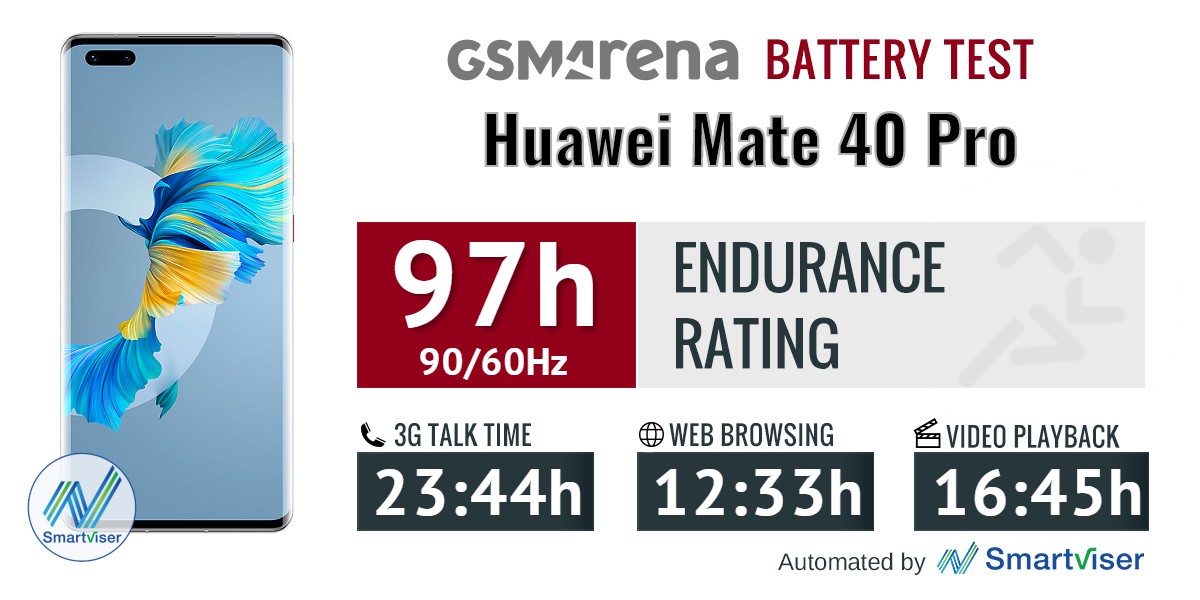
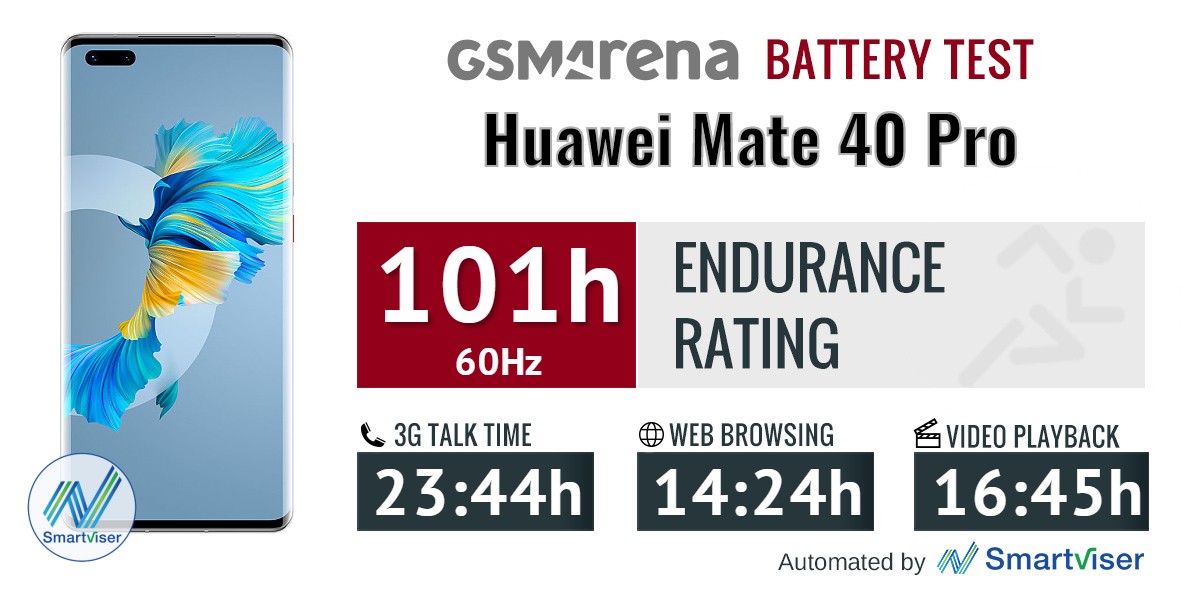
We carried out our usual tests on the Mate 40 Pro, and it was good for a little under 24 hours of 3G voice calls while remaining fairly frugal in standby as well. As for the screen-on tests, we clocked 12:33h of Wi-Fi web browsing at 90Hz, which improved to 14:24 if you run it in 60Hz mode. For video playback, the phone always switches to 60Hz, and in our test, it could loop videos for a little under 17 hours.
Taking everything into consideration, the Mate 40 Pro scored an Endurance rating of 97h with the screen set to 90Hz for web browsing, and 101h if you're scrolling the web at the regular 60Hz refresh rate.
Our battery tests were automated thanks to SmartViser, using its viSer App. The endurance rating above denotes how long a single battery charge will last you if you use the Huawei Mate 40 Pro for an hour each of telephony, web browsing, and video playback daily. We've established this usage pattern so that our battery results are comparable across devices in the most common day-to-day tasks. The battery testing procedure is described in detail in case you're interested in the nitty-gritty. You can check out our complete battery test table, where you can see how all of the smartphones we've tested will compare under your own typical use.
Comparing to other 90Hz phones from this year, the Mate 40 Pro comes up over an hour short of the Mi 10 Pro's browser result (13:44h), while the Motorola Edge+ (14:27h) is good for two more hours than the Huawei in this test. The Mate does inch ahead of the Zenfone 7 Pro (11:57h), though. Browsing at 120Hz takes a bigger toll on the battery, and competitors like the OnePlus 8 Pro (10:58h) and Note20 Ultra (11:31h) can't match the Mate's longevity, much less the Find X2 Pro (9:08h).
When it comes to binge-watching sitcoms offline, the Mate is bested by most competitors, but not by all that much. Plus, modern phones with OLED displays have gotten so efficient that the Mate's 16:45h result is easily good enough. Having said that, you'll be able to get 3+ extra hours on the Motorola Edge+ (20:14h) while the OnePlus 8 Pro (18:03h), Mi 10 Pro (17:44h), and Find X2 Pro (17:38h) will outlast the Mate by about an hour. The Galaxy Note20 Ultra (17:21h) has a minor advantage, too, if you make sure it's running at 60Hz for the task.
Battery charging
The Mate 40 Pro comes bundled with a 66W adapter that's branded Huawei SuperCharge. It uses proprietary technology to get all the 66 watts you need to use Huawei peripherals. We clocked a full charge from flat in 45 minutes with that charger, with 87% showing in the battery indicator at the half-hour mark. While the Oppo Find X2 Pro and the Xiaomi Mi 10 Ultra are quicker, the Mate's numbers are among the best around.
If you happen to be missing your SuperCharger and have a USB PowerDelivery adapter, you can expect something along the lines of 33% in half an hour when starting from empty and a full charge in 1:42h. We got these using a 65W-rated third-party adapter, but the Mate clearly didn't max that out, so a lesser unit will perform similarly.
The Mate 40 Pro also supports wireless charging up to 50W - again, with in-house hardware. Reverse wireless charging is also possible.
Battery settings
Huawei doesn't make a big deal out of it, but the Mate does provide a couple of options to prolong the battery's health over time. One of these is Smart Charge that will delay topping up to 100% depending on your charging habits. Unlike Sony or Asus, there are no settings for this one where you can dial in full charge target times or tie it to your morning alarm - it's just a simple on/off toggle (on by default, by the way).
While Smart Charge was available on the P40 Pro, there's a new one on the Mate. It's called Smart Battery Capacity, and it limits full charges to just short of the battery's top capacity - lithium batteries don't like the 100% state and staying below it helps in the long run.
Speaker test
The Mate 40 Pro has a stereo speaker setup, and it's one of the better ones, conceptually. You get two dedicated speakers, one on the bottom, one on the top, so there's no discrepancy between a 'main' speaker and an earpiece-based sidekick.
X
Huawei Mate 40 Pro
Huawei P40 Pro
Xiaomi Mi 10 Pro 5G
Samsung Galaxy Note20 Ultra 5G
27.258
-25.865
-25.2
-37.097
-25.926
44.348
-15.468
-25.539
-32.01
-24.667
65.574
-13.597
-23.545
-17.771
-23.739
91.616
-18.874
-12.911
-11.929
-22.573
123.122
-13.777
-5.872
-8.488
-14.571
160.746
-6.78
-3.207
-9.402
-8.75
205.164
-1.888
2.327
-6.255
-6.99
257.068
-5.569
1.765
-9.74
-8.589
317.168
-0.73
-6.705
-3.962
-9.706
386.189
-11.879
-11.973
-0.144
-5.919
464.863
-16.836
-17.51
-10.176
-11.144
553.931
-13.788
-19.601
-9.581
-8.391
654.134
-10.55
-16.058
-7.632
-4.379
766.209
-4.403
-7.185
-8.777
-4.215
890.88
0.995
-3.887
-10.846
-5.522
1,028.86
1.1
-1.932
-8.132
-2.526
1,180.84
4.484
-1.589
-5.235
-2.176
1,347.49
8.469
-0.715
-0.359
3.313
1,529.42
10.328
0.71
4.221
7.9
1,727.23
11.632
1.428
7.486
11.589
1,941.47
12.142
5.716
11.01
14.229
2,172.62
7.305
9.501
13.593
16.456
2,421.12
6.962
10.44
12.924
12.916
2,687.33
12.185
8.286
11.632
9.867
2,971.55
11.067
11.318
15.651
14.316
3,274.01
6.563
15.855
16.432
14.318
3,594.84
6.354
13.214
14.698
10.94
3,934.11
10.181
9.77
12.829
5.798
4,291.77
13.645
11.754
9.259
2.37
4,667.69
13.292
13.499
10.43
6.169
5,061.66
9.953
13.578
13.443
12.165
5,473.35
7.781
13.221
12.87
13.114
5,902.32
7.686
10.994
10.582
10.602
6,348.04
8.395
7.394
6.175
10.387
6,809.87
7.617
6.56
4.759
9.955
7,287.07
7.642
7.671
6.003
7.644
7,778.78
7.708
8.187
6.231
6.66
8,284.06
6.893
7.805
6.029
10.639
8,801.83
6.103
8.62
7.212
14.745
9,330.94
6.373
10.444
7.983
16.373
9,870.15
7.026
10.212
8.971
15.7
10,418.1
6.99
8.805
10.977
16.096
10,973.3
6.012
7.243
13.456
16.525
11,534.4
4.511
6.772
15.261
16.984
12,099.6
2.791
5.953
14.383
15.886
12,667.3
0.603
4.025
11.398
14.145
13,235.9
-0.864
0.949
7.939
12.854
13,803.4
-2.739
-2.55
3.513
10.994
14,368.2
-5.305
-6.217
-1.71
8.153
14,928.3
-7.888
-9.526
-6.884
5.022
15,481.8
-9.96
-11.871
-11.993
1.684
16,026.8
-10.698
-13.751
-16.317
-1.354
16,561.4
-10.988
-15.02
-18.798
-3.539
17,083.7
-11.366
-15.599
-19.856
-5.26
17,591.8
-12.245
-15.544
-20.072
-6.863
18,083.7
-13.872
-15.355
-19.452
-7.967
18,557.8
-15.549
-15.144
-18.505
-8.574
19,012
-16.906
-14.967
-17.825
-9.088
19,444.8
-18.217
-14.831
-17.446
-9.689
19,854.4
-19.624
-14.686
-17.202
-10.253
Use the Playback controls to listen to the phone sample recordings (best use headphones). We measure the average loudness of the speakers in LUFS. A lower absolute value means a louder sound. A look at the frequency response chart will tell you how far off the ideal "0db" flat line is the reproduction of the bass, treble, and mid frequencies. You can add more phones to compare how they differ. The scores and ratings are not comparable with our older loudspeaker test.
The reason for that is that most phones that arrived for testing were already excellent in this regard. Whatever difference there was, it was marginal and probably indistinguishable to anything but our lab equipment.
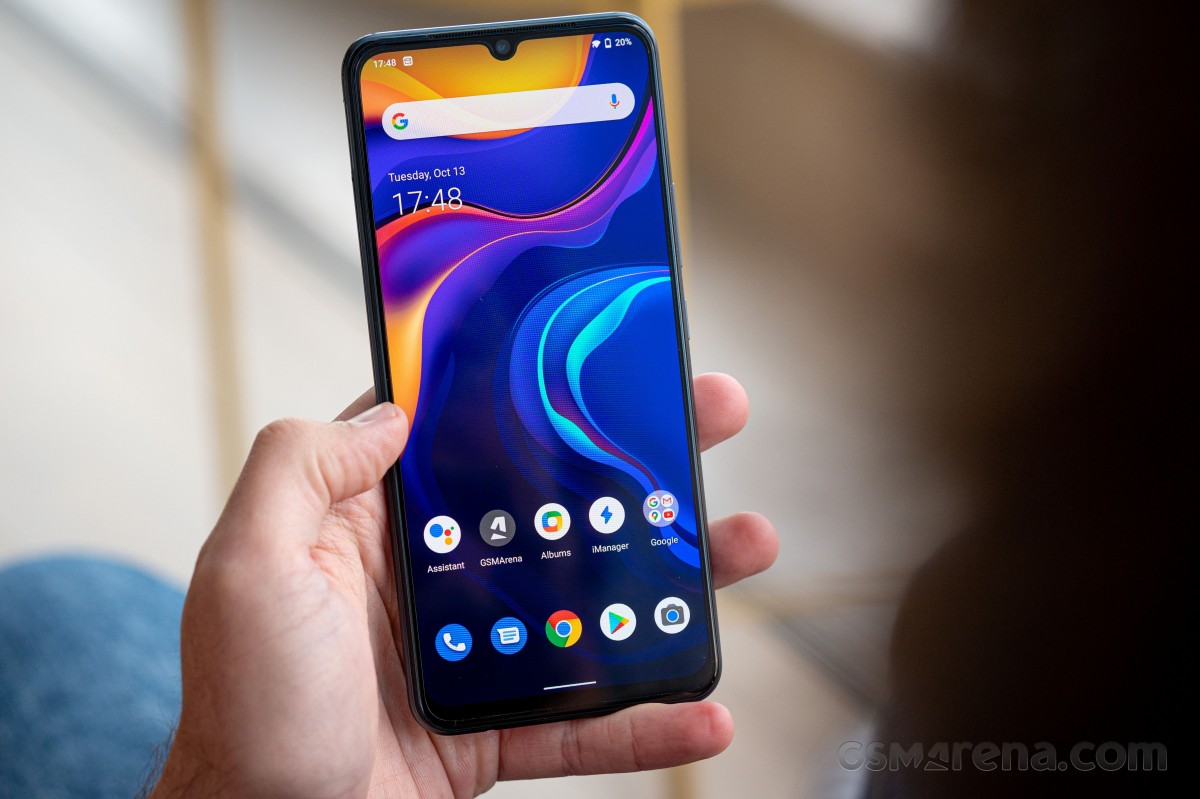
Just today, vivo brought the vivo V20 to the Indian market. Priced at INR 24,990 and INR 27,990 for the 8/128GB and 8/256GB variant, respectively, the vivo V20 is seemingly a great value proposition, but we'll now get the chance to try it and see if that's indeed the case.
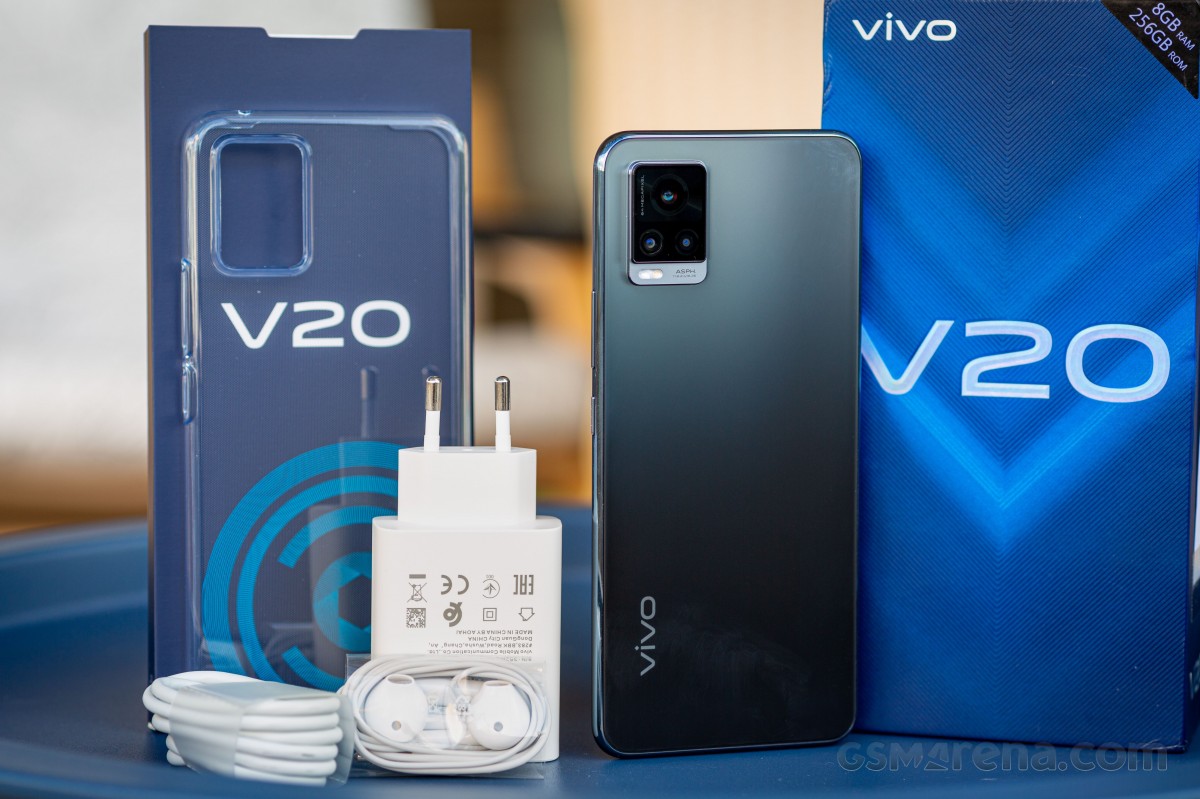
The unit comes packed with all the accessories you could want - a 33W charger, USB-A to USB-C cable, USB-C headphones, and a complimentary silicone case.
https://www.youtube.com/embed/_JKEJbFZfCw
The phone features a 6.44-inch 1080p AMOLED display, which makes the V20 a nicely compact phone. The slim 7.4mm body and the reasonable 170g weight make for a phone that's comfortable in the hand and in the pocket.
vivo has worked hard to ship the V20 with Android 11 already up and running. In fact, the whole Funtoch OS 11 feels very Pixel-like with near-stock icons, a stock power menu, Google's keyboard as standard, and Android 11 exclusive features peppered throughout, like the Conversations, Bubbles, Notification History, Nearby Share, and the stock Focus mode.
vivo has added some of its apps, like the Game Sidebar with 4D game vibrations, its stock Gallery app, FM Radio, iManager, Compass, and the Voice Recorder.
The AMOLED display is nice with good brightness and lovely colors and contrast. The fact that it's barely curved at the sides (2.5D is the preferred marketing term) is refreshing, however, the side bezels are a little thick, taking away some of the glamour from the device.
We found the built-in optical fingerprint scanner quick and very accurate. It works with a simple tap, no pressure required, despite the preinstalled plastic screen protector.
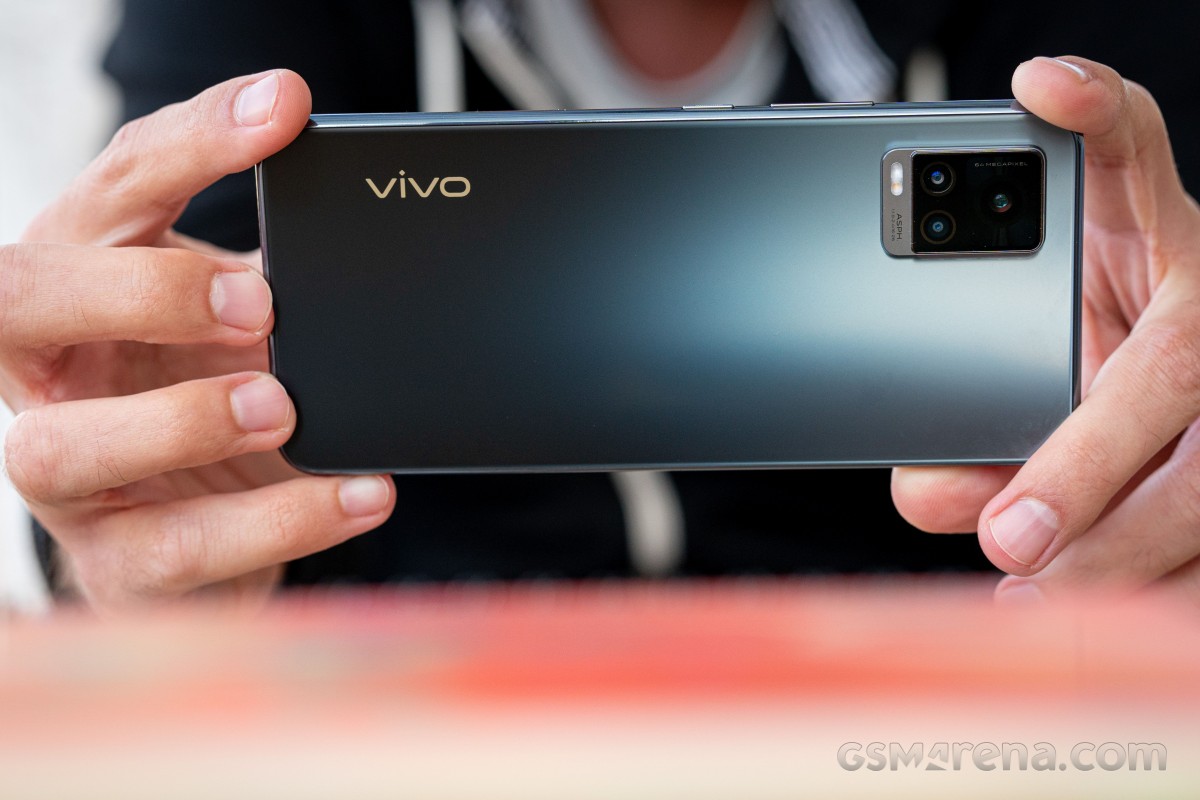
The rear panel has vivo's now trademark gradient finish. It goes from dark grey to silver and even blue under some light. The matte surface feels premium to the touch and doesn't attract fingerprints as readily as a glossy finish would. The side-mounted power button is textured, making it easier to place with a finger.
The cameras are a key selling point of the vivo V20. Its main 64MP snapper bins 4 pixels into one for 16MP resulting snaps. The main 64MP shooter does double duty as a 2x telephoto camera. The other two sensors are an 8MP ultrawide and a 2MP depth camera. Built into a small notch is a 44MP selfie camera. We shot some preliminary samples, which you can see below, but we'll reserve our judgment for our full review.
Stay tuned for our detailed review of the vivo V20!
Your guide to every major social media company's misinformation policies on vital topics from COVID-19 to voting
By Kaveh Waddell. Visualizations by Andy Bergmann.August 13, 2020978 SHARES
An outrageous conspiracy theory vilifying a political candidate. A meme encouraging shots of bleach to fend off COVID-19. An official-looking post falsely announcing that your polling place has moved.
Lies like these seethe on the social media platforms, from Facebook to YouTube to Twitter, where Americans increasingly get their news and information.
These companies say they want to limit dangerous falsehoods while also protecting free speech. But the platforms’ rules on misinformation vary widely. And their policies are often “confusing, unclear, or contradictory,” according to Bill Fitzgerald, a privacy and technology researcher in CR’s Digital Lab.
That makes it hard to know what to expect on each platform, and to choose where to go for important information. It’s also difficult to demand that companies enforce their rules fairly when you can’t even figure out what those rules are supposed to be.
To help sort this all out, Consumer Reports analyzed misinformation policies from the country’s biggest social media platforms. (We also considered public statements by executives.) We focused on the most dangerous types of falsehoods, including misinformation on the coronavirus and on how to vote. Our findings are summarized here.
As you can see, most of the platforms don’t have a blanket rule against posting false material, but they do ban certain kinds of misinformation. Some allow specific types of false claims. Others only sometimes allow a type of false post, depending on details such as the level of danger it may pose. And when it comes to a few issues, a platform may ban all misinformation. (You can click on any icon in the chart for more information.)
We provide more detail below on how platforms handle common categories of misinformation, from vague conspiracy theories to outright lies about the coronavirus or when polling places are open. We’ve grouped Facebook and Instagram because they share a rulebook.
In some cases, companies treat various types of users differently. Facebook and Twitter give world leaders more leeway than ordinary users to post misleading information, at least on some topics, arguing that a leader’s opinions are inherently newsworthy.
Advertisers face the strictest rules on almost every platform. Twitter says it doesn’t allow ads that are “false, deceptive, misleading, defamatory or libelous.” Snapchat says that ads can’t be “false or misleading,” and Reddit ads need to be “truthful, non-deceptive, and defensible,” according to the company. (As CR found earlier this year, it can be easy to get even dangerous health ads approved.)
We shared our results with the social media platforms, and most agreed with what we found. Pinterest disputed our determination, reflected in the charts, that it knowingly allows some misinformation. The company tells CR it bans misinformation of any kind, but its published policies state that it removes only posts that are determined to have the potential to cause harm to users or the public. A Reddit spokesperson said that misinformation on voting is banned, but that’s not included in a published policy.
Snapchat’s written policies say the company allows some false information in cases where the content is newsworthy. But in a statement to CR, Jennifer Stout, Snapchat’s vice president for global public policy, stated that the newsworthiness carve-out does not apply to misinformation about health issues and voting, or to manipulated media. Those would always be against the rules. Snap disputes CR’s determination that certain types of political and social misinformation would be allowed on the platform.
Separately, we’ve prepared a guide to using the companies’ settings to fine-tune what appears in your social feeds, avoiding hate speech, violent images, and hoaxes—or simply tuning out political posts, if you prefer to get your news elsewhere.
We hope that laying all this out will strengthen the consumer’s voice in shaping social media policies on misinformation, and insisting on better, fairer enforcement.
Politics and Social Issues
Companies are largely hands-off when it comes to falsehoods about a broad range of political and social issues. Examples range from a photo of a young Donald Trump flanked by his parents in KKK garb (it’s Photoshopped); to allegations that a hacked Democratic National Committee server is hidden in Ukraine (it’s a hoax); to claims that George Floyd, whose killing by Minneapolis police sparked nationwide Black Lives Matter protests, is a “crisis actor” who’s still alive (that’s untrue, of course).
Social networks generally let people post this sort of thing, although since the 2016 election they say they’ve cracked down on coordinated disinformation campaigns.
But platforms may take actions short of deleting a misleading post. Both Facebook and Twitter label some posts as suspect, with links to more reliable information. They may also bury misleading posts deeper in users’ search results and news feeds. In those cases, you can still find the false information if you go looking for it.
This halfway approach—flag and downrank, but don’t delete—has advantages, says Bridget Barrett, a policy researcher at the University of North Carolina who led a recent study of social media misinformation policies that helped inform CR’s own research. “It feels more honest about the fact that this is complicated,” she says.
Health and Medicine
Misinformation on the coronavirus has been tightly restricted since dangerous falsehoods about the virus swept through social networks starting in early 2020.
Facebook said in May that it had already removed hundreds of thousands of posts and put “warning labels” on about 50 million posts that violated its coronavirus policies. Click on a coronavirus post that Facebook later takes down, and later you might see a big link to a mythbusting page appear at the top of your newsfeed.
“From my perspective, the [policies] that have been most effective . . . are the ones that are hyper-focused,” says Jevin West, director of the Center for an Informed Public at the University of Washington.
Twitter and Facebook recently took down posts showing a news clip where President Donald Trump said that children are “almost immune” to COVID-19 (not true), but plenty of coronavirus-related misinformation still slips through the cracks.
The nonprofit advocacy group Avaaz found dozens of egregious examples of coronavirus misinformation on Facebook that lacked a warning label—including some posts pushing information that had previously been flagged as misleading.
Other health-related falsehoods are allowed to proliferate on YouTube, Twitter, and Reddit, though the companies sometimes bury them behind trustworthy sources. Some platforms ban this content, which can include endorsements of fake miracle cures or anti-vaccination conspiracy theories.
All the platforms we studied have also taken up a new trick to promote safe, authoritative information on COVID-19: Try searching for “coronavirus” on any major network, and you’ll see a special box at the top of your results with links to the Centers for Disease Control, the World Health Organization, or credible news organizations. These results can take up several pages, and similar links have been rolled out for other hot-button issues like voting and suicide prevention.
Voting and the Census
Most social media companies say they have little tolerance for baldly misleading posts about how to vote or to participate in the U.S. Census. Examples would include giving out the wrong hours for a polling place or claiming that people can cast a vote for president online, which they can’t.
However, this is an area where Twitter has diverging rules for world leaders and the rest of us. In the spring, Trump tweeted, falsely, that California was sending mail-in ballots to “anyone living in the state, no matter who they are or how they got there” and that mail-in ballots would inevitably lead to widespread abuses. Twitter added a link explaining that only registered voters received the ballots and that there’s no evidence linking voting-by-mail to widespread voter fraud.
An average user tweeting the same message may have found their tweet deleted instead. On the other hand, the company took no action at all on more recent tweets by Trump making similar claims—including one post in which he floated the idea that the 2020 election would be so flawed it should be postponed.
Twitter has used similar labels for politicians overseas, including in Brazil.
In June, Facebook began adding links to an official government page on voting to every post from a presidential candidate or federal official that mentions voting—whether or not it’s false. CEO Mark Zuckerberg wrote in a Facebook post that the decision stemmed from the “difficulty of judging [the veracity of posts] at scale.”
Critics say the policy erodes an important distinction between lies and legitimate political speech. The same message from Facebook has been added both to unfounded claims that the upcoming election would be rigged and to straightforward posts from candidates asking for votes.
Deepfakes and Manipulated Video
Social media companies are still figuring out how to deal with deepfakes—a new breed of hyper-convincing fake images, audio, and video made possible by fast-developing AI technology. With deepfakes, it’s becoming possible to create a synthetic clip of anyone saying whatever you want them to.
YouTube and Twitter say they will take down particularly dangerous deepfakes—imagine a convincing video of a world leader declaring war, or a powerful CEO reporting false sales numbers—but will leave others alone.
Those platforms also ban videos edited with conventional techniques to mislead people. These videos are far more widespread than deepfakes. This month, YouTube and Twitter both removed a video of House Speaker Nancy Pelosi that was slowed down and edited to make it seem that she’d been slurring her words, as though intoxicated. (Similar manipulated videos of Pelosi have spread widely in the past.)
By contrast, Facebook placed a “partly false” label on the video.
In another example of companies’ different approaches, Twitter labeled a video Trump tweeted as “manipulated” because it included a fake CNN banner and headline. Facebook left the video untouched. (Both companies ended up taking the video down for copyright infringement.)
Misinformation experts say we should expect more of these simple video edits, sometimes called “cheapfakes,” to test the policies put in place by the platforms.
Making the Call on Misinformation
Social media companies use a combination of human teams and computer algorithms to hunt for misinformation. But most companies say little about how they balance the human touch with automated moderation.
The social networks say they have to rely on artificial intelligence because of the unending tidal wave of posts they deal with every day. Many thousands of people work as content moderators for Facebook—but their workload is enormous: In 2017, the most recent data point available, CEO Mark Zuckerberg said Facebook was reviewing more than 100 million posts a month.
Facebook says that 99 percent of the violent and graphic content that it removes is flagged by algorithms—ditto for 97.7 percent of the posts related to suicide and self-injury, and 88.8 percent of hate speech, according to the most recent data. Of course, these numbers don’t include the posts that Facebook doesn’t catch.
Automated moderation is much more likely to make mistakes than people are, computing experts say. “Machine learning can’t do it, and it’s not even close,” says UW’s West, who teaches courses on AI. Humor and sarcasm often slip through machines’ grasp, for example.
That helps explain why social media companies are often accused of leaving up posts that should come down—and deleting posts that shouldn’t. Journalists and researchers have turned up rampant examples of voting misinformation, falsehoods about Black Lives Matter protests, and conspiracy theories about vaccines.
Many social activists have complained about being put in “Facebook jail,” having their accounts being suspended for discussing racism, even while some blatantly racist posts are left untouched.
“In some cases, what actually happens doesn’t match up with the stated policy,” says Nathalie Maréchal, senior policy analyst at Ranking Digital Rights, a nonprofit that grades tech companies on factors including their privacy and content moderation practices. “We urgently need more transparency from companies” about enforcement.
Experts in the field say that consumer pressure could lead the platforms to do more. In July, hundreds of advertisers pulled ads from Facebook, following popular outcry against lax policies toward hate speech and misinformation. In recent months, Twitter, Reddit, YouTube, and Facebook have all thrown dangerous conspiracy theorists off their platforms.
“When social media is so intrinsic to how society works, citizens should have some say on what those policies are,” West says. “We are consumers of these major platforms that we don’t necessarily pay for—but we could still make choices with where we spend our time.”
The long-awaited lawsuit follows a year-long investigation into the tech giant and lays the groundwork for one of the most significant confrontations between the U.S. government and a web company in decades.
The states of Arkansas, Florida, Georgia, Indiana, Kentucky, Louisiana, Mississippi, Missouri, Montana, South Carolina and Texas all joined as plaintiffs in the suit, according to the docket in D.C. district court.
"As the antitrust complaint filed today explains, [Google] has maintained its monopoly power through exclusionary practices that are harmful to competition," deputy attorney general Jeffrey Rosen said.https://products.gobankingrates.com/r/d9360ea31bf06ea8b9d0ef49288e28fb
Among the accusations against Google in the lawsuit is that it unlawfully pays phone carriers and other web browsers, like Apple's Safari, billions of dollars each year from its search advertising revenues in order to be the preset default search engine on those platforms, according to associate deputy attorney general and senior advisor for technology industries Ryan Shores.
Shores said as a result of its anticompetitive practices Google currently maintains search distribution channels accounting for roughly 80% of general search queries in the U.S.
"Ultimately, it is consumers and advertisers who suffer from less choice, less innovation and less competitive advertising prices," Shores said. "New models for search are emerging but if they have any chance to challenge Google they must have an effective way to distribute their product, so they can build a user base."
In a statement Tuesday, Google described DOJ's lawsuit as "deeply flawed" that "would do nothing to help consumers."
"People use Google because they choose to, not because they're forced to, or because they can't find alternatives," said Kent Walker, Google's Senior VP of Global Affairs and Chief Legal Officer. "The Department's complaint relies on dubious antitrust arguments to criticize our efforts to make Google Search easily available to people."
Rosen disputed the idea that the lawsuit was in anyway rushed and brushed off the fact that many states previously in talks with DOJ declined to sign on as plaintiffs.
"I think it'd be fair to say from our coordination with states that we've seen general support as to the issues that are in play," Rosen said. "There have been some states that chose not to join this complaint in some states that are choosing to proceed on their own path but not out of a lack of support for what the concerns are."
In a separate paper statement, Attorney General William Barr praised the suit as a "monumental case" and previewed potential future action by the Justice Department against tech companies as a result of its still ongoing review into their alleged anti-competitive practices to maintain control of the market.
"This is an important milestone, but not the end of our review of marketleading online platforms," Barr said. "The Department will continue to vigorously investigate and enforce the antitrust laws where appropriate to protect and promote competition in the digital economy for the benefit of the American consumer."
Stocks declined Monday as Wall Street monitored signs of progress on a U.S. stimulus package before the Nov. 3 presidential election.
The Dow Jones Industrial Average fell 153 points, or 0.54%, to 28,452, the S&P 500 fell 0.58% and the Nasdaq was down 0.4%.
TheStreet's Katherine Ross discussed breaking news in the stock market on Street Lightning. Cramer spoke about Boeing stock, Abbott and the deal between ConocoPhillips and Concho.
Boeing: Buy Or Sell?
American Airlines plans to let customers take trips on its Boeing 737 MAX jets as early as this year - more than 18 months after the jets were grounded.
"Based on the current plan, flights beginning Dec. 29 will be the first flights for paying customers," an American Airlines spokeswoman told TheStreet.
Cramer said this is the time to buy more Boeing. "Boeing has bottomed (out). I think this American Air Max is a very big deal. The market which has been weary should look at the TSA numbers this weekend which were over a million for the first time and realize Boeing has bottomed and you've gotta buy it."
Gallery: How Southwest, Spirit and Other Airlines Have Fared in 2020 (GOBankingRates)
Abbott Labs: Buy Or Sell?
Abbott Laboratories is expected to report net income of $1.6 billion, or 90 cents a share, on sales of $8.5 billion before the market opens on Wednesday, based on a FactSet survey of 19 analysts.
Cramer said if you're an investor Abbott is certainly right. "It's breaking out again. Remember it's got Libre 2, a fantastic diabetes glucose monitoring system."
The ConocoPhilips, Concho Deal
ConocoPhilips will buy Concho Resources in an all-stock deal valued at $9.7 billion. Last week's rumors bore fruit, with the two companies agreeing to a deal.
Concho shares were up about 1% on the news, but that comes after the jump last Wednesday of 10.2% when M&A reports first started surfacing.
But ConocoPhillips' desire for Concho started more than a week ago. From TheStreet's morning coverage of the deal:
"ConocoPhillips, Bloomberg reported, had been hinting about a potential deal for months. In July, Lance said the company was encouraged by the low premiums needed for acquisitions in the shale sector, citing Chevron's deal to buy Noble Energy for about $5 billion."
Cramer said," I think these are two very disciplined companies. I have long liked Concho. Conoco has got a really good balance sheet. They are certainly doing a lot of things right but Conoco stock is down 47% for the year."
Boeing and Abbott are key holdings in Jim Cramer's Action Alerts PLUS charitable trust. Want to be alerted before Jim Cramer buys or sells any stock?


 Shot with primary camera
 shot on ultra-wide







 © Walter Bier/Keystone via AP, FILE The Google logo is seen on the front door of the Google Engineering center in Zurich, Switzerland, March 6, 2008.
 © Walter Bier/Keystone via AP, FILE The Google logo is seen on the front door of the Google Engineering center in Zurich, Switzerland, March 6, 2008.
